innermatter

Duality within growing darkness

The light was fading, and we had started from a place of acknowledging global suffering. Our consideration of dualities led to many group insights – as a pull between certainty and uncertainty, towards and away from equilibrium, “there are as many ways to view a problem as there are people in the circle.” We talked about grief, and trauma as ghosts as taught by Piikani Elder Reg Crowshoe. I also pointed toward the colonial shadow learning offered by Dr. Rosa Morales and her social media channels. All this was to consider what we may be carrying or interacting with that is beyond our conscious awareness. Some practical advice that emerged was to “lean thoughtfully into skepticism” when needed, as well as the reminder that we are doing this work within the responsibility of being future ancestors to those who come after us.

Within these heavy reflections, we were reminded of the importance of grace, and to welcome emotions whenever and wherever they arrive. The balance that came in was through stories and reverie with whales, and specifically protective maternal whales, and kinship between the lives and presence of whale mothers and human mothers. To spend some time with the cultural presence of whales, the NFB animated film Sgaana was recommended, as well as the book Grayson, by Lynne Cox. To witness whale grief in the world, a For the Wild podcast also came up – with Kurt Russo of the Lummi Nation, called The People Under the Sea. An additional episode with him, titled On a Prayer of Mourning, released in the last couple days will likely also hold teachings for this group.

Lastly, and guided by the reminder to “not let the world kill my heart,” as taught by Mohawk seed keeper, Rowen White in an October social media post, we were also pointed to the BBC series Ghosts as a place for lightness and laughter when it’s needed.
Witnessing, mapping & counter-mapping

Meeting in September during the week of Orange Shirt Day and the National Day of Truth and Reconciliation, witnessing was an important emphasis. We shared strategies for effective and compassionate listening, as well as carefully challenging subtle and overt denialism as guided by the writing of Daniel Heath Justice and Sean Carleton at this link. One of our group members offered a personal practice that has supported them to engage in difficult conversations like this, with the following steps:
– Pause
– Validate what is being shared
– Request permission to respond to them with additional reflections
– Speaking from the heart about their own feelings

We also reflected about connection to land, beginning by thinking of mapping in a conventional sense, considering our linear journeys to places that are special to us. Then to close, we came back to the same place with the prompt below, as inspired by the concept of counter-mapping, which is explained in this article and illustrated in this beautiful video with Zuni community member and museum director Jim Enote.

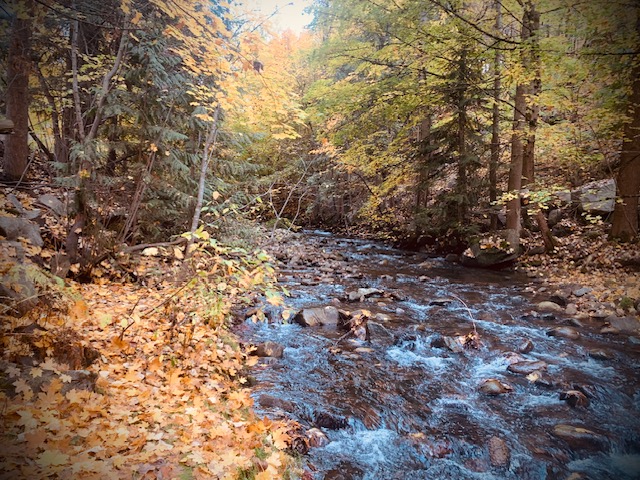
Go back in your mind to that place that brings you calm and clarity, put your awareness in the stream, lake, forest our mountain, and witness yourself arriving there, instead of your path of travel. Each place has a unique spirit. How does the place see you? Does it have any messages or guidance for you? What are the constellations you carry of story to that place and away again? How could you honour it with art, story, song, prayer, weaving, making?

In complexity, decolonizing in roles and life

As a final opportunity to meet before the busyness of school life took over for many of us, and the seasons begin to shift for all, it was inspiring and motivating to hear of each person’s summer journeys in decolonizing thought and action. We spent some time reflecting about news items that may have been missed due to silencing on social media platforms and google searches. We opened with a prayer in acknowledgement of the Turtle Lodge‘s invitation to join in a “National Day of Prayer: A Call for Spiritual Unity” taking place that day in alignment with the full moon. We engaged in discussion regarding the complexity we each take up regarding land acknowledgements, as inspired by teachings from Smokii Sumac, shared at an event during the Nelson Mural Festival. We also considered what strengths we bring to diverse roles in institutions and communities, as articulated by Deepa Iyer’s Social Change Ecosystem Framework.

Looking forward to staying on contact through the seasons ahead – continuing to meet monthly, speaking and listening to each others’ journeys. May we each receive the strength and encouragement we need to keep doing our best during the intervening weeks as well!

Witnessing truth, layering strength

When we gathered in July, it was a small group, and our time was spent in states of creative and metaphoric reflection. We also gave space to emotional responses working with current events through our ongoing purpose of facing truth. With the twin circumstances of denialists attempting to dig up children’s remains at Tk’emlúps and colonial governments refusing to excavate Winnipeg landfills to search for remains of Indigenous women believed to be there, we witnessed the bleakness of Indigenous experiences in Canada. This gave pause and also purpose, knowing that most will either avoid, gloss over, or even affirm the dehumanization in evidence. As people dedicated to decolonizing intentions, we must linger and remain open, even as it brings up grief, anxiety, and even visceral terror at the nature of the society in which we live, work and dream.

Collectively, we have many sources for sustaining the personal strength required to do the ongoing work of challenging colonial mindsets and structures. It was heartwarming and empowering to hear each participant share names of Indigenous people they feel supported by, whether through personal relationships or writers who inspire them. May we continue to learn and connect in a good way over the coming year, supporting one another to grow paths and momentum for decolonization against barriers that arise.

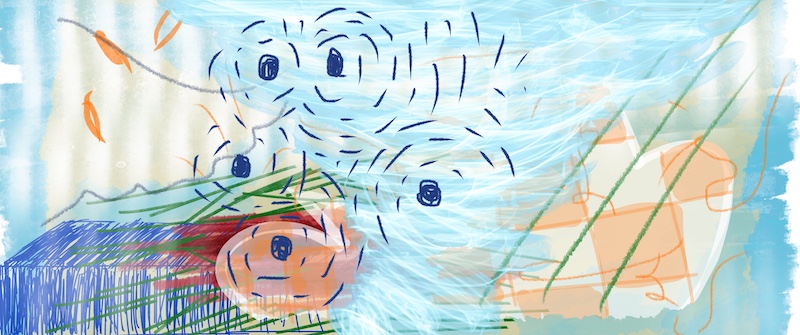
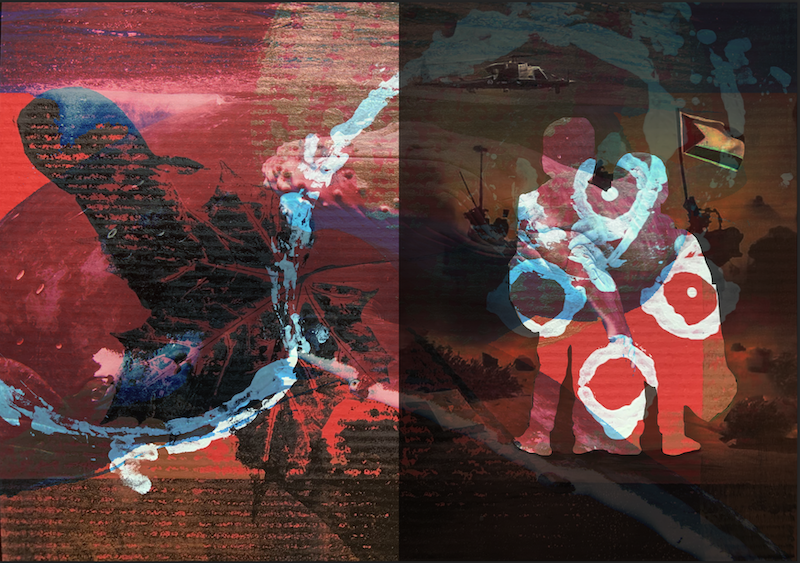
Working with a short and flexible artistic prompt, each participant created initial visual metaphors for their journey in decolonization, and then added another layer after further conversation. The third step in the process was generating the collective layered version above, presenting one synthesis of the memory of our conversation. Hopefully each person can sense if not see the presence of their contribution to the whole. One image was not included since it was only shared privately not with the full group. It would have added a floating dead fish, a common sight in the over-warm waters of July. This contribution reminds us that even when skies are clear in a season of abundance, we should carry the thread of intention to make a difference not just for the Indigenous people who suffer within societal denial, but also for plant and animal relatives who equally need our care and concern. 

Who is here?

Our first zoom meeting with the From the Heart Inquiry circle was much better attended than I expected since it took place during such a busy week. There were nine of us, all logging in from the Kootenays this time, but with others who had expressed interest from further afield who will hopefully be able to join us next time.

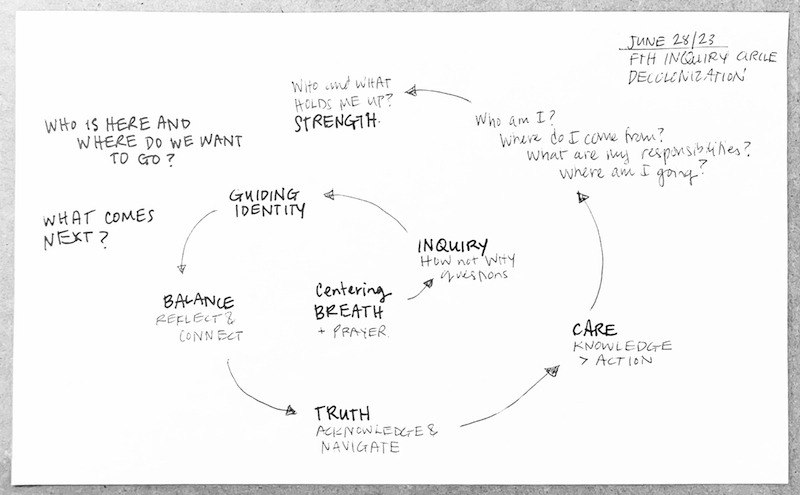
This is the first of monthly follow-up posts that will allow us to have an archive of our process and catch others up if they want to join later. Here is a 12-minute video summary I made after the meeting, which felt like a better answer than recording it. The image above was the plan I had, that we didn’t end up completing (this is often the case for me, I’m an over-planner). We got as far in the spiral as acknowledging the truth and beginning to think about areas of focus. I am not sure if we will pick up the same spiral at the end of July, or if new priorities will come to the forefront. Below are the discussion questions that we took turns responding to, in case anyone who attended wants to revisit them, or others want to join or follow along.

~ What is your name and an aspect of your identity that feels important to share today? We intend to get to know one another more deeply over time.

~ What initial how/what/who inquiry question can you form to introduce us to your interests in decolonization? Miniipoka (Peter Weasel Moccasin) shares that an overemphasis on “why” questions is one problem with European thought.

~ What are activities you undertake to promote balance between internal/self and active/outward states in your life? We are looking to enact balance in our lives every day or week as an expression of the balance we hope to contribute to in the world.

~ Considering the necessity to include a focus on difficult truths as we build better worlds, what is an issue or colonial impact you feel you can contribute to? The truths I offered as I presented this question included a focus on genocide, which is well served by this new NWAC resource called “Teach the Genocide.”

Invitation to collective inquiry

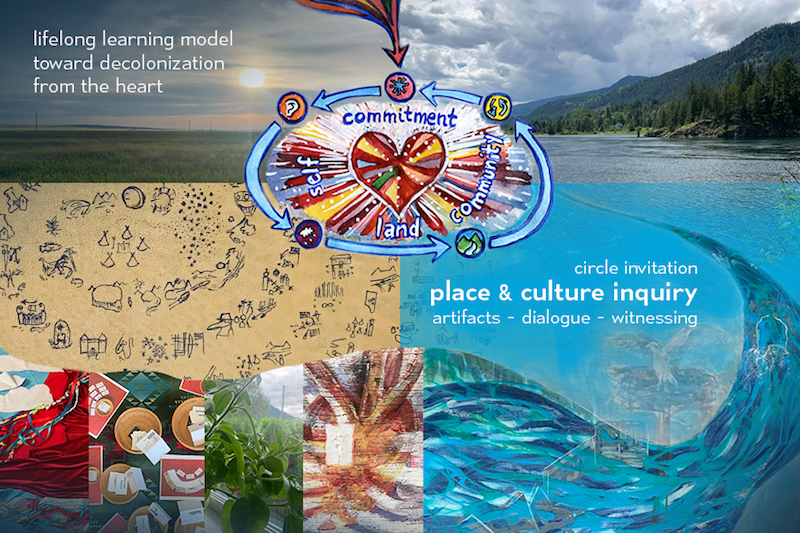
Through my capstone project for the Poo’miikapii: Niitsitapii Approaches to Wellness program, I worked with a few amazing teachers at Calgary Girls Charter School in the mode of artistic inquiry. We made a culture and worldview inquiry resource that will likely be shared on this site eventually. I have also worked in artistic inquiry for the last four years through the recurring youth and community project I support, called From the Heart. I realized that I wanted to take up this method in my own learning, not just hold space for others. The above invitation was shared with various individuals I know who are also focused on decolonization. Below is the starting point I offered to see if anyone would come forward to join in this collective pursuit.

This invitation is being sent to a varied group who I have had conversations with over the last couple months about the possibility of embarking upon deeper learning relative to place, land, culture and personal history. I am thinking of it as an open-ended forum for individual and collective strength-building that will help us navigate decolonization and address complexity as thinkers, leaders or decision-makers. 

For the moment, this is what I am picturing: over the coming year, I will offer monthly reflection prompts, an online space for resources and connection, and one monthly zoom. All of this will be optional, and which will hopefully integrate with in-person or side-channel partner collaborations to deepen the witnessing that is possible.

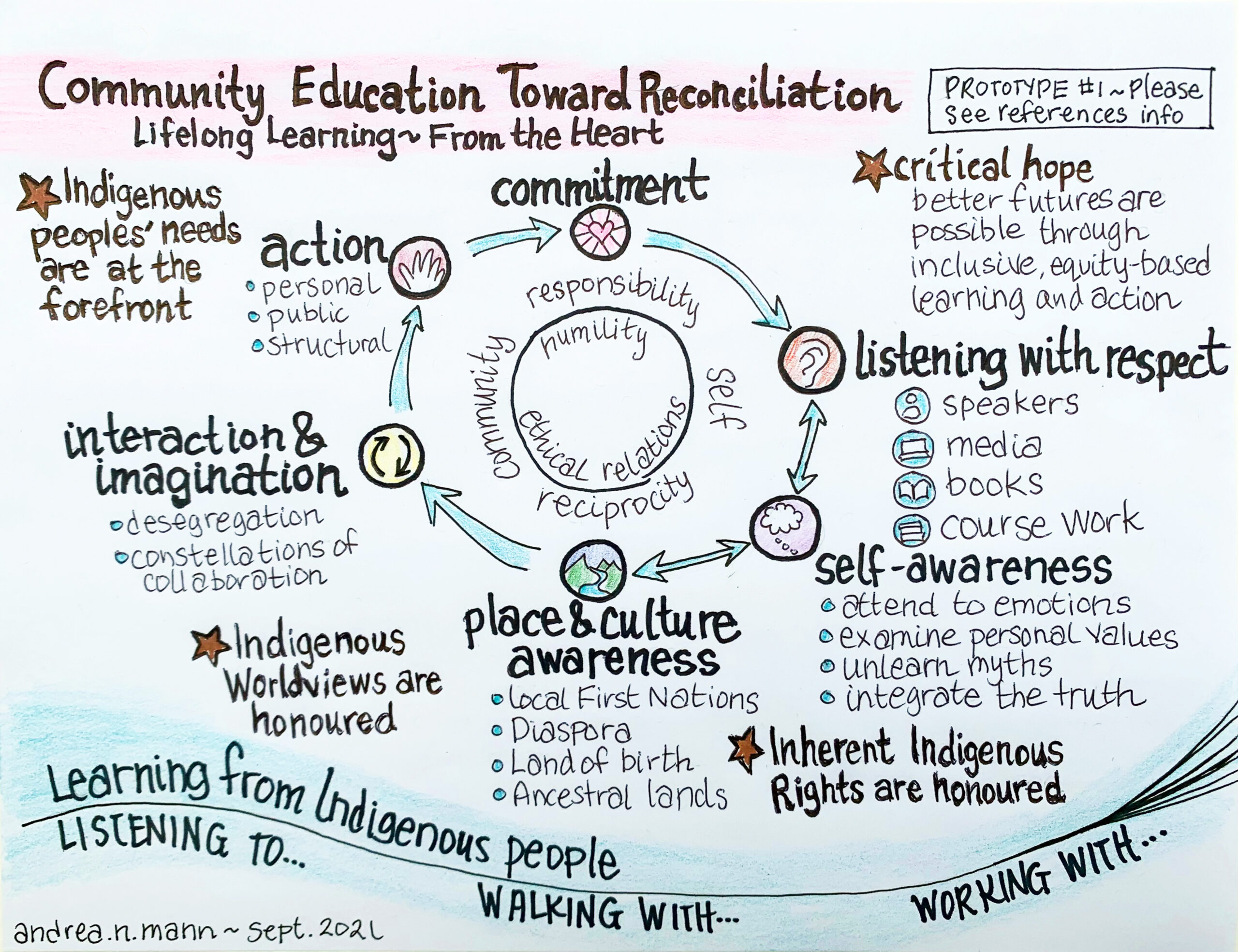
It’s about discovering and speaking the stories that bring forward our “precolonized consciousness” from our “jagged worldviews” as articulated by Dr. Leroy Little Bear in his well-known chapter in the book Reclaiming Indigenous Voice and Vision (Ed. M. Battiste, 2000). It is also an extension of collaborative work with Christy Anderson since 2021 building the lifelong learning model most of you will have seen – which can be viewed and downloaded from this link

In Blackfoot territory, this process could look like developing your own winter count, which I am happy to support from my own experiences last fall. As other examples, one member of the group will likely compile and catalogue recordings of her grandmother’s storytelling, and I am planning to begin working in the medium of embroidery, as my ancestors from Jämtland might have. Several people in the group are deeply invested in Indigenous language learning, so I wonder if that will be their focus. The concrete approach is up to each of you, whatever connections you want to work through, and the medium that resonates for making your exploration tangible in some way if you are called to.

Synthesis begins…

Almost two years has passed since my last post, time that has held constant and crucial learning for me, as someone who is committed to decolonization as a primary purpose in my life and work. I am grateful to now have had the opportunity to also learn through Poo’miikapii: Niitsitapii Approaches to Wellness at the University of Calgary Werklund School of Education, building upon my first year in the Indigenous Education: A Call to Action program. I am forever grateful to respected Elder Ninna Piiksii (Mike Bruised Head), Ahstanskiaki (Sandra Manyfeathers) and their communities, for the teachings, wisdom and support they have offered since last summer. I hope to sustain the relationships with them, classmates and community in Blackfoot territory, in reciprocity for the transformative learning I experienced.

I have now started the culminating third year for the completion of a Masters of Education building upon these focus areas, and looking toward the hopeful prospect of future studies, along with continued learning and teaching in many directions. This website has been a holding space with very little traffic, but I am about to start using it in earnest to bring a coherent online presence to my many roles and responsibilities. The structure and content will undergo transformation that reflects my own. Whenever we grow, we must also find space and time for synthesis. This is the phase I am entering.

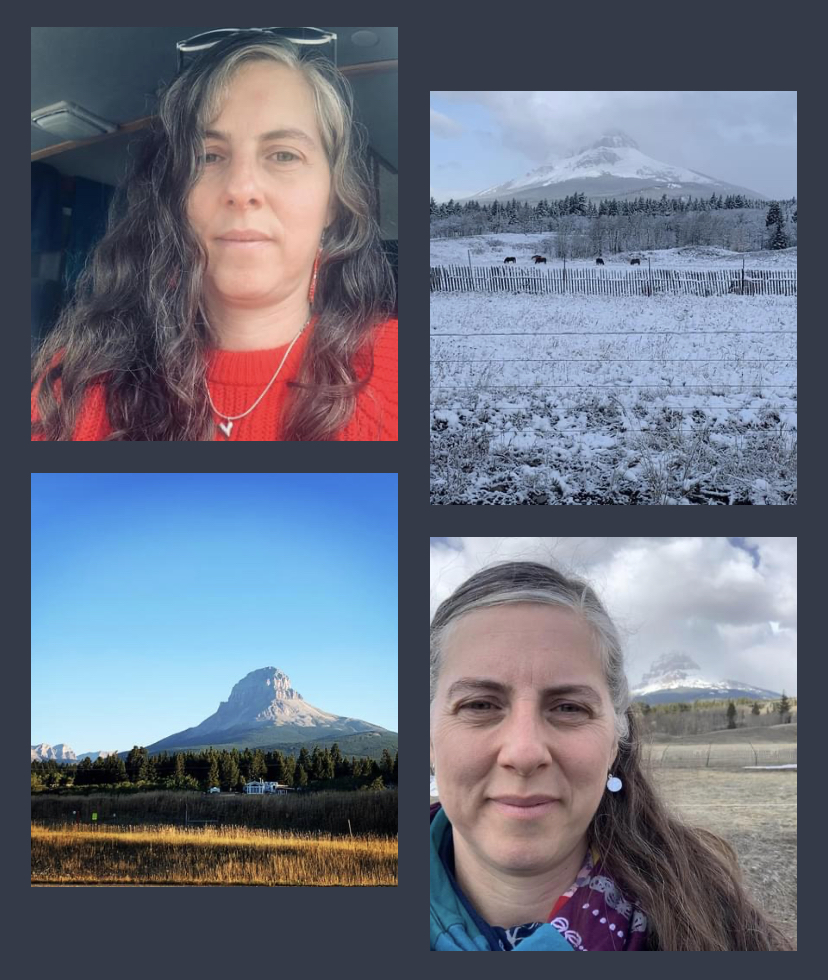
For info about the photo below, here is my social media post from April, as I returned home and stopped to greet and thank Omahkai’stoo. See this link for context and stories from Ninna Piiksii.

Tired but hopefully wiser – nine months, a million miles, listening, reading, dreaming and a couple hundred pages of writing, so much love. Now finished my incredible learning sabbatical visiting the beautiful Niitsitapii lands and people. I’m so grateful to the professors, Ninna Piiksii and Sandra Manyfeathers, the amazing classmates and community, and to Marco and Alexia for their support and patience.

I have greeted and thanked Omahkai’stoo so many times as I passed. It won’t be quite so often now, but always joyful.

“Niitaissatsii’p Miistakiists Niitaksimkatoop Nahkai’sts (when I look at the mountains, I think about going home)” posted years ago by Cuts Wood School is true today, and has been all year. But now I also know more. Yes, I feel at home in the mountains, but now I know that the mountains have names, medicines, cultural and vision quests sites to be returned to the Niitsitapii people. Their home. Land back. Life back. Niitsii (truth). Poo’miikapii (unity, harmony and balance). Thank you for your stories and teachings. I will think of you and visit often, and happily connect and collaborate in between! 🗻🏇🏻❤️

Learning toward reconciliation

As we look ahead to the first annual National Day of Truth and Reconciliation next week, it is apparent, in our community at least, that there has been a leap in interest toward getting involved in reconciliation efforts. The prototype pictured in this image, and available for download with references at this link, represents the collaborative starting point for what will hopefully become a deep local commitment to the learning and work of systemic and interpersonal growth in our region. I am grateful to the collaborative partners in many circles who are looking for productive paths forward together. So far we are working in informal ways, and are always motivated to share, so feel free to reach out with feedback, questions and connections!

Looking ahead to service learning

The completion of the Learning Leap site today is the final learning task in completion of my first two courses in the Indigenous Education: A Call to Action program, but its intention is looking ahead. In September I will begin a course titled Critical Service Learning and Engaged Scholarship in Indigenous Education, which will involve seeking a community partner and arriving at a shared vision for a capstone project I will complete during winter term. I have some ideas and initial contacts out, but a plan will emerge through dialogue, and further learning and reflection.

It will be exciting to see what projects each of my classmates will put together as well. From what we have heard, previous program graduates have initiated amazing work in their communities. It will be an honour to contribute to the legacy of this impactful program.

In the meantime, I am also looking forward to a few weeks of rest and renewal so that I am ready for the challenges ahead. It has been a transformative and rewarding summer despite the fires and smoke, despite the pandemic. I am so grateful.

Learning Leap evolves…

Below is the description that was posted for this site in October 2020, which I’m about to re-work entirely. There were definitely some leaps in learning at Mount Sentinel during the school year, but not as much time to document it all as I thought there might be. Life has brought many new opportunities for learning since then. I’m excited to be re-thinking and re-imagining possibilities for the work and creativity of taking leaps toward better futures in the the West Kootenay region and beyond!

Learning Leap is a web-based initiative to support dialogue and learning, through intersectional and anti-racist lenses. To begin, the staff at Mount Sentinel Secondary School, a small community school in South Slocan, BC, are taking this leap by reading and sharing 13 books during the 2020-21 school year, and invite others to learn along with us. We are taking an appreciative inquiry approach, and are inspired by the leadership of #DisruptTexts on Twitter. We are grateful to the writers for sharing their stories and perspectives and will honour their work not only by learning from them, but also by being influenced in our teaching practice, since this leap is also for and with the youth.